Broken Garage Door Spring Repair in Phoenix, AZ
A broken spring turns a garage door into a few hundred pounds of dead weight. Call and a local technician replaces the springs matched to your door, checks the cables and drums that work with them, and balances and tests the door before leaving. You hear the price first.
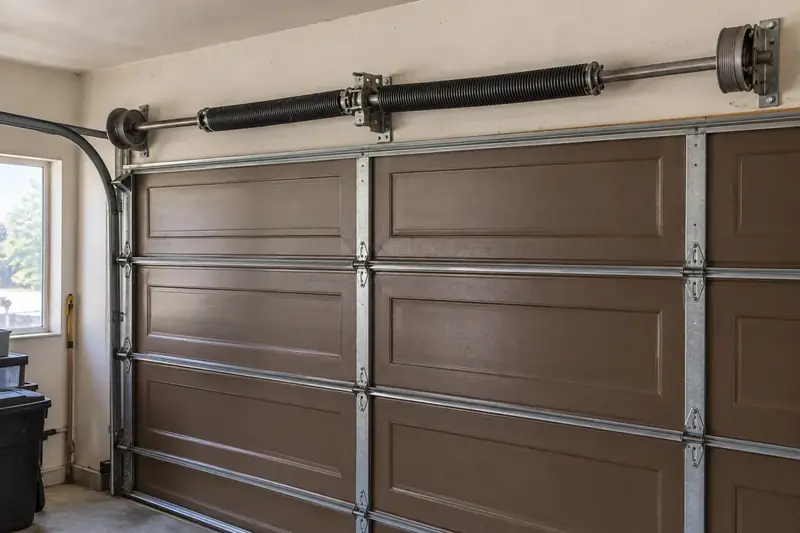
How garage door springs work
The opener does not lift the door. Springs do. They counterbalance almost all of the door's weight so that a door weighing well over a hundred pounds moves with a light push, and the opener only has to guide it. When a spring breaks, that counterbalance is gone.
Most two-car doors in Phoenix use torsion springs mounted on a steel shaft above the opening. As the door closes, the springs wind up; as it opens, they unwind and turn cable drums that lift the door by its bottom corners. Older and lighter doors may use extension springs instead, which stretch along the horizontal tracks on each side.
Each spring is sized to the door: its weight, height, drum size and how many springs share the load. A spring chosen by eye leaves the door too heavy or too eager to rise, and either one wears out the opener and the rest of the hardware.
Signs of a broken garage door spring
- A sudden loud bang Often at night or in the morning, from a spring letting go. Look from a safe spot for a gap in the coil above the door.
- The door lifts a few inches and stops The opener senses too much weight and quits or reverses.
- The door feels very heavy by hand It has lost its counterbalance. Do not keep testing it.
- One side rises faster than the other A spring, cable or drum problem that can twist the door out of its track.
- A cable hanging loose Cables go slack when the spring that tensions them breaks.
- The opener runs but the door does not move A broken spring can look exactly like a broken opener.
If you see a gap in the spring, stop. Do not run the opener, do not try to lift the door and do not touch the cables or bottom brackets.
Why springs break in Phoenix
Springs are rated in cycles, one open and one close. A typical standard spring is built for roughly ten thousand cycles, which a household using the garage as its main entrance can reach in several years. Phoenix heat does not break springs by itself, but summers of heating and cooling, rust starting at a scratch, and dry, unlubricated coils rubbing together all add wear. Many springs finally go on a cool morning after the first cold snap.
Whole subdivisions in north Phoenix, Desert Ridge, Ahwatukee and Laveen were built within a few years of each other, and their original springs are reaching the end of their cycles at about the same time. If your neighbor's spring just broke, yours may be close.
Torsion and extension springs
| Spring type | Where it sits | What to know |
|---|---|---|
| Torsion | On a shaft above the door | Most two-car doors; usually two springs, replaced as a pair |
| Extension | Along the tracks on each side | Older and lighter doors; need safety cables run through them |
| Higher-cycle | Either type, heavier wire | Last longer on doors used many times a day |
On a two-spring door, both springs have done the same work. When one breaks, the other is close behind, and replacing both at once usually saves a second visit. The technician should explain the condition of the spring that did not break.
Extension springs must have a safety cable threaded through each one. Without it, a broken extension spring can whip across the garage. Older Phoenix garages sometimes have extension springs that were installed without them.
What a spring repair visit includes
- 01
Confirm the setup
Door type, size and weight, spring arrangement and whether the door is in a safe position.
- 02
Check related hardware
Cables, drums, bearings, bottom brackets, rollers and track, which often wore alongside the spring.
- 03
Price before work
What failed, what else is worn and the cost, before anything is replaced.
- 04
Replace and balance
Springs matched to the door, wound or set correctly, the door balanced so it stays put halfway up.
- 05
Test
Full open and close cycles, opener force and travel, photo eyes and the safety reverse.
At the end you should know what broke, why the new springs fit your door, whether any cable or roller work was needed, and how the door was tested. The invoice should name the parts installed and any warranty on parts and labor separately.
Spring safety for Phoenix homeowners
Do
- Keep people, pets and cars away from a hanging or crooked door.
- Unplug the opener if the door is stuck partway.
- Note the door's position and whether a car is inside.
- Take a wide photo from a safe spot if it helps you describe the problem.
Do not
- Run the opener against a heavy door.
- Pull a cable, loosen a bottom bracket or try to wind a spring.
- Pull the manual release on a door that is partly open; it can drop.
- Stand under a partly open door to look at the spring.
Spring tension is enough to break bones. Winding a torsion spring takes proper winding bars, clamps and the specifications for that door, and garage door safety guidance from the industry is clear that it is not homeowner work.
How long garage door springs last
Spring life is counted in cycles, not years. One cycle is one trip up and one trip down. A household that opens and closes the door four times a day uses roughly fifteen hundred cycles a year, so a standard ten-thousand-cycle spring lasts about six or seven years. A garage that serves as the front door, a home gym or a workshop can use that up in half the time.
Higher-cycle springs use heavier wire and a longer body to spread the load, and are commonly built for twenty thousand cycles or more. They cost more and need enough room on the shaft, so they are a choice for doors that run many times a day rather than an automatic upgrade. Ask the technician which cycle rating is being installed and how it was sized to your door.
- Count a normal day Each time the door goes up and comes back down is one cycle. Morning and evening commutes, school runs and trips to the bins add up quickly.
- Multiply by the year Four cycles a day is about fifteen hundred a year; eight a day is about three thousand.
- Compare with the spring That tells you roughly how long a standard spring lasts on your door and whether a higher-cycle spring makes sense.
Cables, drums and bottom brackets
A torsion spring does its work through the cable drums at each end of the shaft. The drums wind the lift cables, and the cables pull on the bottom brackets at the lower corners of the door. When a spring breaks, the cable on that side often goes slack or jumps off its drum, and the door can sit crooked in the opening.
Phoenix garages add their own wear. Monsoon winds push dust and grit under the door, and dry bearings and gritty cables make the whole system work harder. A careful spring repair includes the cables, checked for fraying and kinks; the drums, checked for cracks and correct winding; the bearings at each end of the shaft; and the bottom brackets, checked for rust and bending.
A frayed lift cable is replaced, not twisted back together. If one cable is worn, the other has done the same work and should be looked at too.
What affects the price of spring repair
This site does not publish a spring price, because the right spring depends on the door. What changes the cost is easy to name on the call and confirm at the visit:
- The number of springs One on many single-car doors, two on most double doors, sometimes more on heavy custom doors.
- Spring type and size Torsion or extension, wire size, length and cycle rating.
- Related parts Cables, drums, bearings, rollers or bottom brackets that wore out alongside the spring.
- Door condition A door that came off its track or bent a section needs that work as well.
- Timing Ask on the call whether an evening or weekend visit costs more.
A clear quote names each part, says why it is needed and keeps parts and labor separate. If a whole new door is suggested because of one broken spring, ask what else failed. For a price on your door, call or use the quote form.
Spring repair or a new garage door?
A broken spring on its own is almost never a reason to replace the door. Springs are a wear part, made to be replaced. A new door starts to make sense when the door itself is failing: sections cracked or rusted through, a frame bent by a car, a wood door split and warped by the sun, or a door so heavy from old repairs and added glass that it no longer balances well.
If replacement is recommended, ask to see the damage that makes the door not worth repairing, and ask for the spring repair price so you can compare the two. A door that ran unbalanced can also strain the opener, so the garage door opener repair guide explains how the opener is checked at the same visit.
Keeping new springs working
A few simple habits help new springs last. None of them involve touching the springs, cables or brackets.
- Look and listen once a month Run the door and watch for jerky movement, a gap in a coil or a cable that looks frayed. Listen for scraping or grinding.
- Check the balance safely Only with the door fully closed and working normally: pull the release, lift the door by hand to about halfway and let go. A balanced door stays roughly in place. If it drops or rises on its own, call.
- Keep the threshold clear Gravel, dust and debris along the bottom make the door work harder and can confuse the safety sensors.
- Ask about lubrication Many door makers suggest a light garage-door lubricant on springs, hinges and rollers. Ask the technician which product suits your door.
If anything looks wrong, stop using the door and call. The spring safety list above covers what not to do while you wait.
Springs and the rest of the door
A spring repair is often the moment to catch the parts that wore out alongside it. The lift cables are the most common: when a spring breaks, a cable often slips off its drum, and a frayed cable is replaced at the same visit. Garage door cable repair explains that job, and every other repair is listed on garage door repair in Phoenix.
Garage door spring repair questions
How can I tell if my garage door spring is broken?
A visible gap in the coil above the door, a loud bang and a door that suddenly feels very heavy are the usual signs. Look from a safe spot and stop using the door.
Can I use the opener with a broken spring?
No. The opener is built to guide a balanced door, not lift its full weight, and it can strip its gear or bend the top panel.
Should both springs be replaced?
Usually, yes. Both have the same number of cycles, and the second one tends to break soon after the first.
How long does spring replacement take?
Usually about an hour or two, including balancing and testing, when the right springs are on hand.
Can I get my car out with a broken spring?
Do not try to lift the door yourself. Tell the person who answers that a car is trapped so it is part of the plan.
Why did my spring break in winter?
Cold mornings are when worn springs often fail, after a summer of expansion and contraction.
Do you replace springs anywhere in Phoenix?
Yes, across the city of Phoenix. See the neighborhoods served.
How long do garage door springs last in Phoenix?
Usually several years. A standard spring is built for about ten thousand open-and-close cycles, and heavy daily use wears it out sooner.
Are higher-cycle springs worth it?
For a door that runs many times a day, often yes. They cost more and must be sized to the door, so ask for both options on the call.
Are the cables checked when a spring is replaced?
They should be. Cables, drums, bearings and bottom brackets are checked on a spring visit, and any worn part is priced before work starts.
Should the opener be checked after a spring breaks?
Yes. An opener that kept trying to lift an unbalanced door can be strained. See garage door opener repair.
Door stuck in the heat? Call before it gets worse.
Call now(602) 000-0000Mon to Fri 8am to 7pm, Sat 9am to 3pm (Arizona time). A person answers, asks what the door is doing, and sets up a visit with an independent local garage door technician who works Phoenix.