Garage Door Opener Repair in Phoenix, AZ
An opener that clicks, hums, reverses or ignores the remote can be a small fix or a sign the door itself has a problem. Call and a local technician checks the door and the opener together, finds the real fault and gives you the price before any repair.
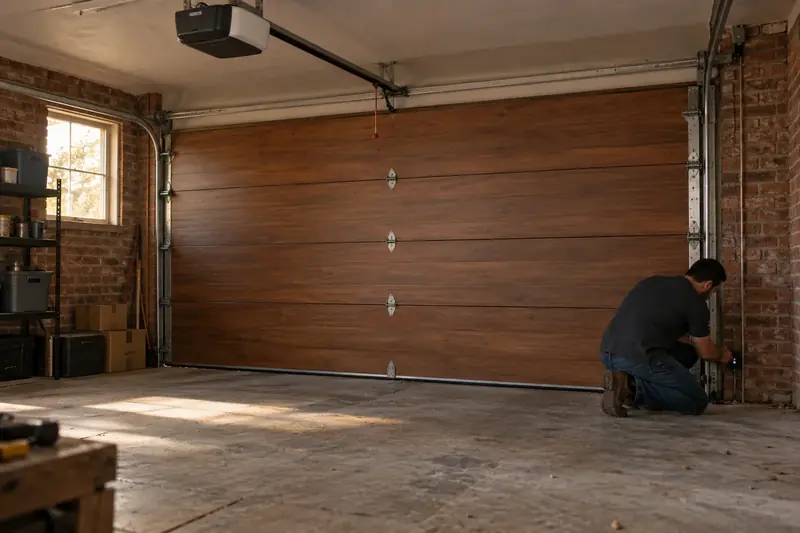
Opener or door: finding the real fault
An automatic opener is built to move a door that is already balanced by its springs and runs freely in its track. If the door is heavy, crooked or binding, a new motor will not fix it, and a stronger opener only hides the problem until something else breaks.
That is why the diagnosis starts by separating five things: power, the controls (wall button, remotes, keypad, app), the drive (gear, belt or chain, trolley), the safety sensors, and the door itself. Which of them works and which does not points to the fault.
"The wall button lights up, the opener clicks twice and the door stays closed. The remote does the same thing." That is more useful than "the opener is broken."
Common opener problems in Phoenix
- No lights or response Power, the outlet, a tripped breaker or the opener's board. Monsoon outages and surges are common culprits.
- Wall button works, remote does not A dead battery, lost programming, lock mode or a failed receiver.
- Motor hums, door does not move A stripped gear, a disconnected trolley, a broken belt or chain, or a broken spring.
- Door closes partway, then reverses Blocked or sun-blinded sensors, a travel or force setting, or something dragging in the track.
- Noisy or slow Worn drive parts, a loose rail, dry rollers or a door that is out of balance.
- Keypad or smart control unreliable Batteries, programming, Wi-Fi or a keypad cooked by the sun.
Heat, sun and power: why Phoenix openers fail
Opener electronics and backup batteries age faster in a garage that stays above 110 degrees for weeks at a time. Many opener failures in Phoenix are boards that quit in July and August, and backup batteries that swell or stop holding a charge after a couple of summers.
Afternoon sun is the other Phoenix problem. On a west-facing garage, low sun can shine straight into the receiving photo eye and blind it, so the door reverses as if something were in the way. The fix is usually a sensor shade or swapping the sending and receiving sides, not a new opener.
Monsoon storms bring power flickers and outages that can erase programming or damage a board. After an outage, note whether the opener lights up and whether all controls stopped at once.
Safety sensors and doors that will not close
The two photo-eye sensors near the floor on each side of the opening send an invisible beam across. If it is blocked or the sensors point the wrong way, the opener will not close the door, or reverses it. A bin, a bike tire or a pile of leaves can do it, and so can a bracket knocked loose.
The sensor lights help describe the problem, though their meaning varies by brand. Tell the technician whether one or both lights are on, steady or blinking, and whether the opener's lights flash after a failed close.
Never bypass the sensors to make the door close. They are what stops a closing door from landing on a child or a pet.
When the motor runs but the door will not move
A running motor does not prove the opener is connected to the door. The trolley may have been released, the drive gear may be stripped, or the belt or chain may have broken. Just as often, a broken spring has made the door too heavy, and the opener gives up.
Do not keep pressing the button. The opener can overheat or bend the arm and the top panel. If the door is crooked or hanging, keep clear and unplug the opener.
Remotes, keypads and smart controls
If the wall button works but one remote does not, try a fresh battery and a second remote. If every remote stopped together, the opener may be in lock mode, or its receiver or programming has failed. Outdoor keypads in Phoenix take direct sun and can fail from heat alone.
Smartphone control adds Wi-Fi, an account and an app that can each fail separately. If the wall button and remotes still work, the opener and door may be fine. Never share your account password; use the manufacturer's setup to add access.
If a remote is lost or stolen, ask the technician to clear the opener's memory and reprogram the controls you still use.
Opener repair or replacement
| Finding | Repair may make sense | Replacement may make sense |
|---|---|---|
| Remote or keypad failed | A battery, programming or a compatible control fixes it | Controls are no longer made for an old receiver |
| Sensor fault | Alignment, shading, wiring or a new sensor | Required parts are no longer available |
| Drive gear or board failed | The model has parts and the rest is sound | Repeated board failures in the heat, no parts |
| Door heavy or binding | Repair the springs or track first | A new opener only after the door runs correctly |
When comparing a repair with a new opener, include installation, controls, removal of the old unit, programming and safety testing, and the separate product and labor warranties. A belt drive is quieter where there is a bedroom beside or above the garage; a backup battery keeps the door working in an outage, and in Phoenix it is worth asking how long the battery is expected to last in the heat.
What to tell the technician
- Which controls work The wall button, each remote, the keypad and the app.
- What moves The motor, the rail, the trolley and the door after a command.
- Lights and codes Blinking sensor or opener lights.
- When it happens Every time, only in the afternoon, or after a storm or outage.
- The model If the label is easy to see from the floor. Do not climb a ladder for it.
Types of garage door openers
| Drive type | How it works | Good to know |
|---|---|---|
| Chain drive | A metal chain pulls the trolley along the rail | Durable and common; the loudest type |
| Belt drive | A reinforced belt does the chain's job | Much quieter; a good fit beside or under a bedroom |
| Screw drive | A threaded steel rod moves the trolley | Fewer moving parts; can be sensitive to big temperature swings |
| Wall-mount | Sits beside the door and turns the torsion shaft | Frees the ceiling; needs a suitable spring setup |
The drive type changes which parts wear and how loud the opener is, not whether it can lift the door. Every type depends on springs that balance the door. A heavier door needs a correctly rated opener, but a bigger motor never makes up for springs that are out of balance.
In a Phoenix garage, ask how the opener and its electronics handle long stretches of heat, and whether the model you are offered has parts readily available locally.
The monthly safety reverse test
Openers made for sale in the United States since 1993 must have a second safety system against trapping someone, most often the photo-eye sensors near the floor. The opener should also reverse when a closing door meets something solid.
Garage door industry safety guidance suggests a simple monthly check. With the door open, lay a piece of two-by-four flat on the floor in the middle of the doorway and close the door. It should reverse when it touches the wood. Then, while the door is closing, pass an object such as a roll of paper towels through the sensor beam. The door should stop and reopen.
Use an object for the test, never a hand or a foot, and keep children away from the door while it moves. If either test fails, stop using the opener to close the door and call.
Battery backup and power outages
Some openers carry a backup battery that runs the door for a limited number of cycles when the power is out. In Phoenix that matters most during monsoon outages, when a closed door can also trap a car. Backup batteries are a wear part, and garage heat shortens their life; many need replacing every couple of years. An opener that beeps or shows a battery light is often telling you the battery is failing.
Without a backup battery, the door can be opened by hand during an outage with the manual release, but only when the door is fully closed and the springs are intact. If a spring is broken, do not release the door; it can be far heavier than it looks.
What affects the price of opener repair
- The part that failed Controls and sensors are usually simpler fixes than a drive gear, circuit board or motor.
- The opener's age and brand Parts for older or discontinued models can be hard to find.
- The door's condition Spring, roller or track problems found at the same visit are priced separately.
- Replacement choices Drive type, motor rating, battery backup, smart features and extra remotes or keypads.
- Timing Ask on the call whether an evening or weekend visit costs more.
Ask for the repair price and, if it is close, the price of a replacement opener installed, so you compare like for like. For a price on your door, call or use the quote form. The spring repair guide covers the most common reason an opener seems to fail.
Helping an opener last in the heat
- Keep the sensors clean and shaded Wipe dust off the lenses and ask about a sun shade if afternoon sun reaches one of them.
- Keep the door in shape Balanced springs and smooth rollers keep the motor from straining every cycle.
- Change remote and keypad batteries before summer Heat drains small batteries faster than you expect.
- Ask about surge protection Monsoon surges damage opener boards; a surge protector rated for the opener outlet can help.
- Never turn up the force to make the door close If the door reverses, find the cause instead of overriding the safety system.
Openers and the rest of the door
Many calls that start as an opener problem end at the safety sensors, especially on west-facing doors in the late afternoon. Garage door sensor repair covers that job, and every other repair is listed on garage door repair in Phoenix.
Garage door opener repair questions
Why does my opener run but not lift the door?
The trolley may be disconnected, the drive may be stripped, or a broken spring has made the door too heavy. Stop pressing the button and call.
Why does my door open but not close?
Usually the sensors are blocked, blinded by sun or out of line, or something is dragging in the track.
Can a broken spring look like a broken opener?
Yes. The opener tries to lift a door that has lost its counterbalance and stops after a few inches.
Do I need a new opener because the keypad failed?
Not usually. A keypad may need a battery, reprogramming or a compatible replacement.
Why did my opener stop after a monsoon storm?
Outages and surges can erase programming or damage the board. The technician checks power, programming and the board.
Will a new opener make my door quieter?
Only if the opener is the noise. Worn rollers, loose hinges and a dry track make most of the noise and need their own fix.
Do you repair openers anywhere in Phoenix?
Yes, across the city of Phoenix. See the neighborhoods served.
Which garage door opener is quietest?
Belt-drive and wall-mount openers are usually quieter than chain drives, but a noisy door also needs its rollers and hinges checked.
How often should I test the safety reverse?
Once a month: an object on the floor in the doorway, then something passed through the sensor beam. If either test fails, stop using the opener to close the door.
Why does my opener keep beeping?
Often a backup battery that is failing or discharged, especially after a Phoenix summer. Note the pattern and tell the technician.
Can the opener and the springs be fixed at one visit?
Yes. The door and the opener are checked together. See garage door spring repair.
Door stuck in the heat? Call before it gets worse.
Call now(602) 000-0000Mon to Fri 8am to 7pm, Sat 9am to 3pm (Arizona time). A person answers, asks what the door is doing, and sets up a visit with an independent local garage door technician who works Phoenix.